Commercial logistics & freight
When port Wi-Fi drops, a mark on each container still confirms what it is, whose it is, and where it has been — a custody trail built at the gate with no network. The barcode/RFID alternative, with logic attached.
Wherever a mark must carry an owner, trigger an action, resist cloning, and be verified without a network. Logistics is where Nocmark™ lands first — then defense custody, product authentication, and search, rescue & remote sensing, where the same mark is read from drone and satellite. Looking for digital & file identity? →
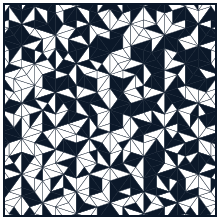
Example — every mark is a unique, non-repeating excerpt of an infinite aperiodic field.
A printed code is frozen the moment it is made. If the status of an item changes, or the logic behind it needs updating, the asset has to be found and re-tagged. Nocmark opens a different door: the physical mark never changes, but what it means can.
Update what a mark links to or triggers over the air. The same object on the same shelf can mean something new tomorrow — no reprint, no re-tag, no interception of stock already in the field.
Move a lot of product to a recalled state without recovering it first, so the next authorized scan at dispensing or intake flags the item on the spot.
As requirements change, the logic behind a deployed mark changes with them. The asset adapts without a hardware recall or a second deployment cycle.
The same core capability — a programmable mark that triggers an action when an authorized device sees it — runs across commercial industry, logistics, defense, and search & rescue. Each resolves verification and custody at the source. A few of the arenas; the patent’s embodiments extend further.
Tamper-evident chain-of-custody for materiel and goods — from manufacture and warehousing to last-mile handoff. Where Nocmark lands first.
Asset custody and provenance that hold up when connectivity is jammed or absent — on materiel, vehicles, and gear.
Anti-counterfeit, regulated-lifecycle carriers, and brand and content provenance across a range of industry sectors.
High-contrast marks on lifeboats, canopies, and equipment, resolved by drone and satellite. Task a sensor to watch for a mark; on recognition, the programmed response fires — with no connectivity at the scene.
Every solution below shares one need: proving what an item is, whose it is, and where it has been — without depending on connectivity at every hop. That is the logistics thread Nocmark is built around, and where it complements and/or competes hardest against barcodes, RFID, and networked track-and-trace.
Seal an item's identity and origin at the source, so everything downstream references a tamper-evident record rather than a copyable label.
Read and route locally, even when facility Wi-Fi or port networks are unstable. Update an item's status over the air without re-tagging stock in place.
Establish an unbroken custody trail across partners and borders, with tamper and substitution flagged at each authorized read.
A representative set — not exhaustive.
A passive mark any authorized sensor — handheld, gate, or drone — reads to confirm identity and build a tamper-evident custody trail, with the network jammed or down. A logistics and custody capability, not combat ID.
When port Wi-Fi drops, a mark on each container still confirms what it is, whose it is, and where it has been — a custody trail built at the gate with no network. The barcode/RFID alternative, with logic attached.
Flip a drug’s status to “recalled” over the air without recovering stock; a scan at dispensing flags it on the spot. Custody and recall control down to the package.
Meet mandates like the EU Digital Product Passport with a carrier that stays updatable for a product’s whole life and resists cloning onto a counterfeit — where a static QR or RFID label falls short.
A mark tied to the owner and device-gated (a photo of it is inert to an unauthorized reader) confirms a genuine item at the shelf in a single scan — no cloud round-trip, no guesswork for the buyer.
Anchor a real scene to a tamper-evident mark at the moment of capture — a physical-world provenance layer that complements C2PA as synthetic media spreads.
Seal a pass/fail decision at the camera and trigger a reject arm; or mark low-power field assets that resolve locally — no server round-trip, within tight thermal budgets.
Each application is positioned as authenticity, provenance, and custody. Capabilities not yet field-tested are described as designed and intended.

The same aperiodic mark can be produced in whatever medium your operation demands — and the right choice is confirmed on your own materials and sensors, not assumed. When a partner runs a live validation test, the material, spectrum, and placement are part of what gets characterized.
Peel-and-stick labels, large-format signage, paint on a surface, or fibers woven into fabric, uniforms, and gear — the mark carries the same identity in each.
Rendered in the visible band, or in thermal and other spectra for covert marks the naked eye can't see but an authorized sensor can. Which spectrum fits is confirmed against your readers.
Placement, range, angle, and lighting are measured on your own substrates and sensors during a live validation test with our team — so a deployment is scoped on evidence, not guesswork.
Tell us the problem you're solving and we'll scope a first use case grounded in what the technology does today.