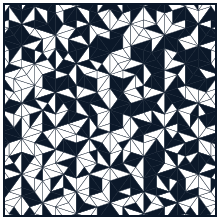
A Nocmark™ doesn’t need a surface. It can live on a screen, project into a scene, or exist as a pure electronic image that serves as a file’s identifier — bound to an owner, carried in an image chain. When an authorized system reads it, it fires an action you define — release a shipment, unlock a record, or authorize a transaction. Looking for physical-world & logistics? →
The same aperiodic mark — on a crate, on a screen, or as the name of a file.
The mark carries owner, state, and a programmable action whether it’s printed on the world or living inside a system. A few of the forms this takes; the patent’s embodiments extend further.
Display the mark on any screen, or project it into a scene. An authorized camera reads it exactly as it would a printed mark — useful for handoffs, kiosks, presentations, and displays where nothing is physically tagged.
The Nocmark image can serve as a file’s identity inside a system — standing in for a filename, bound to a user, and carried in an image chain that records custody and state. The identifier is the artifact, not a label attached to it.
Because the mark is programmable and device-gated, an authorized read can do more than confirm identity — it can fire a programmed action of your own design the moment it’s recognized. Everything unassigned sees nothing it can read.
Data, code, media, and records need the same guarantees a shipping crate does — a verifiable owner, a tamper-evident history, and an action that fires only for the right reader. As a digital identifier, Nocmark brings that to files and transactions, resolved locally, with nothing readable to leak to anyone else.
Bind a media or data file to a user with a mark that travels as the file’s identity — and can be re-pointed over the air without renaming or re-issuing the file.
Give records a programmable identifier that an authorized system resolves to their custody history and access rights — on screen, in a database, or bridged to a physical file folder.
A mark that lives in a file or on a screen is governed exactly like one on a crate. The controls travel with it, and they are set when your deployment is built.
A digital mark resolves only on the hardware and systems you assign, and can be narrowed further to a geographic area you set. To anything unassigned it stays unreadable, so a file that travels does not become a file that leaks.
Where a mark is read from a screen or a scene, it works with the AI computer vision you already run, or with the recognizer Response Images provides. Detection shortlists a candidate; the exact cryptographic layer makes the decision.
Resolve inside your own environment with no round-trip, check against a registry when you want central oversight, or run a hybrid. Configured in the Nocmark Studio built for you after a briefing.
Whether the identity lives on a crate or inside a file, we’ll scope a pilot grounded in what the technology can do today.