A crate crosses six borders. A file moves between three systems. A convoy loses its signal in a valley. From the loading dock to orbit, industries that must trust what they see have to answer the same question without waiting on a network: is this real, untampered, and whose is it?
Nocmark™ gives an object — or a digital file — a one-of-a-kind mark that never repeats, tied to its owner. Only the devices you assign can read it; to everything else it stays invisible. On a match, it triggers the action you programmed — verified right where it’s seen, online or off.
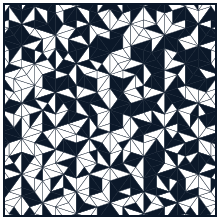
Example — every mark is a unique, non-repeating excerpt of an infinite aperiodic field.
Every mark, distinct by construction.
Each mark is a non-repeating excerpt of an aperiodic field — unique by the math it’s built on, not by chance. See it generate distinct marks in the live demo.
No specialized or rip-and-replace hardware — Nocmark runs on the CPUs, cameras, drones, and satellites you already operate, benchmarked on commercial server infrastructure. Measure it on your own machine in the live demo; request a briefing for the full server-tested results.
Marks resolve locally, on the device that sees them. Measure the real latency on your own hardware in the live demo.
Verifying locally removes the central-server load a per-scan round-trip would create — less back-end hardware, less bandwidth, and lower energy draw, with savings largest at the edge.
No network is required to read a mark. Add a secure round-trip only when you want one: edge, connected, or hybrid is your choice, per deployment.
Every mark is a non-repeating excerpt of an infinite aperiodic field — a one-of-a-kind fingerprint by construction.
A printed code is frozen the moment it's made, and it only encodes data. Nocmark marks carry an owner, trigger an action, and can be re-pointed over the air — while the physical mark never changes. The same object can mean something new tomorrow without ever being re-tagged.
Update what a mark links to or triggers over the air. The physical mark stays put; no reprint, no re-tag.
On a match, the mark triggers a programmed action of your own design — seal a custody record, flag an anomaly, raise an alert, or reprogram what it does next.
Printed, woven into materials, or outside the visible band — read by the sensors already in the field.
Readable only by the hardware you assign, and — when you want it — only inside a geographic area you set. Everyone else sees nothing they can read.
Being frozen is only half the problem with a printed code. The other half is what it depends on: a round-trip to a central service just to say what it is. Jam the link or lose the signal, and that dependency becomes the failure.
Barcodes and RFID are passive carriers. The reader captures an identifier and sends it off to be interpreted, and the answer comes back only if the network is there to carry it. Where connectivity is contested or absent, the tag has little to say on its own.
The mark carries its owner and its programmed action with it. An assigned device resolves it at the point of capture, seals a tamper-evident record, and fires your action — building a custody trail across partners, borders, and dead zones, no round-trip needed.
The same core capability — a programmable mark that triggers an action when an authorized device sees it — works in the physical world and as pure digital identity. Logistics is where it lands first; these are a few of the arenas, and the patent’s embodiments extend further.
Tamper-evident chain-of-custody for materiel and goods, manufacture to last mile — where Nocmark lands first. Plus product authentication, defense custody in denied environments, and search, rescue & remote sensing, where marks resolve from drone and satellite and fire a programmed response on recognition.
Logistics · Defense · Product authentication · Search & rescue · Remote sensing
On a screen, projected into a scene, or as a pure electronic image that serves as a file’s identity — bound to a user, carried in an image chain. An authorized read can trigger a programmed action of your own design. Meaning without a physical object at all.
File identity · On-screen & projected · Transaction triggers · Image-chain custody
A partial map of sectors where a reprogrammable, tamper-evident mark opens new capability.
Contested-logistics custody and provenance for materiel.
Custody and authenticity that survive network dead zones.
Marks tied to an owner, hard to clone, verifiable at the shelf.
Tamper-evident custody and recall-aware unit marking.
Engagements take different shapes — a proof of concept, a scoped pilot tested on your own substrates and sensors, a design-in during your R&D, or a licensing arrangement. We scope the right one with you, starting from a real use case, not a fixed process.
So the next time a crate crosses a border, a convoy loses its signal, or a counterfeit reaches a shelf — the mark still answers. Real, untampered, yours. See it hold offline in the demo, then we'll scope the right engagement. Technical papers available on request.